
The average service-based business loses between $10,000 and $50,000 annually to inefficient customer support operations. Repetitive inquiries go unanswered. Response times stretch into hours. Customer frustration builds. And your support team drowns in preventable work.
But what if that could change overnight? In 2026, businesses deploying AI automation in customer service are reporting something remarkable: cost reductions of 30 to 40 percent while actually improving customer satisfaction. They are not laying off employees. They are reimagining what work looks like.
The Hidden Costs Killing Your Service Business Profitability
Before discussing solutions, let us face the problem directly. Your service business operates on thin margins. Whether you run a hospitality operation, healthcare practice, or consulting firm, customer support eats into profit every single day. Here is what happens in most service businesses:
- •Manual Ticket Management: Customers call or email with basic questions. Your team spends 10 to 15 minutes finding answers.
- •Extended Response Times: Without 24/7 availability, customers wait. Delayed responses lead to higher churn.
- •High Labor Costs: Staffing for peak hours and after-hours support is expensive. A single full-time agent costs $35,000 to $55,000 annually.
- •Consistency Gaps: Service quality varies by person. Customers receive inconsistent experiences.
- •Recurring Errors: Manual data entry and ticket misrouting create expensive rework.
How AI Automation Actually Works (And Why It Is Different from Chatbots)
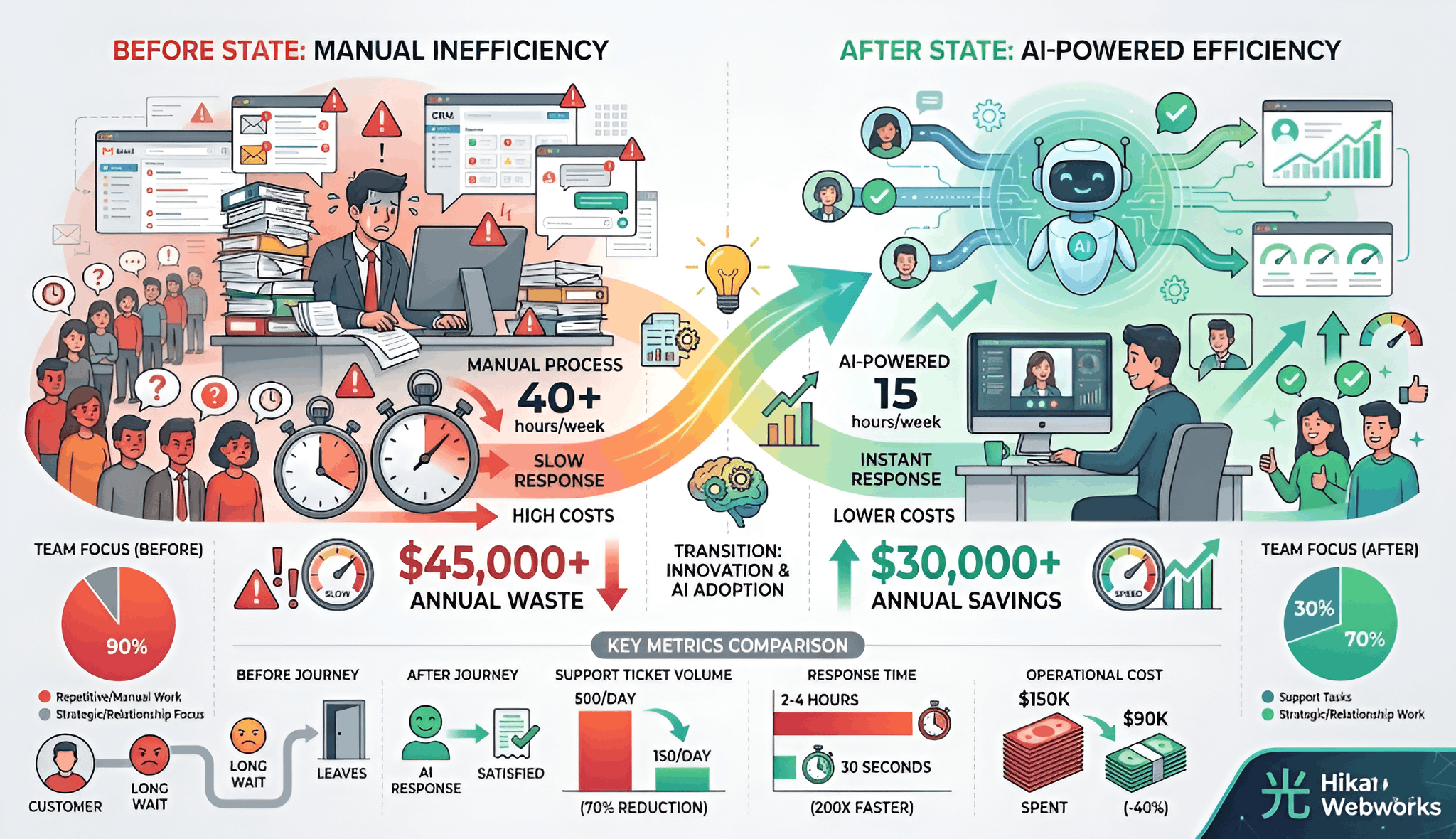
AI automation in 2026 goes far beyond simple chatbots answering frequently asked questions. Modern AI systems are intelligent agents that understand context, make decisions, and execute multi-step tasks across your entire business stack.
- •Real-Time Customer Interaction: AI voice agents answer instantly, 24/7.
- •Intelligent Task Execution: The AI directly accesses systems to process payments or schedule appointments.
- •Smart Escalation: Smoothly transfers complex issues to humans with full context.
- •Learning and Improvement: Each interaction teaches the system to handle more complex scenarios.
The Measurable Financial Impact: Real ROI Numbers
The financial case for AI automation in service businesses is compelling. Automation can cut operational costs by 30 to 40 percent. For a service business with annual support costs of $150,000, that represents $45,000 to $60,000 in annual savings.
- •Labor Cost Reduction: AI handles repetitive work, reducing agent requirements by 30%.
- •Error Reduction: Automated systems follow defined processes perfectly, reducing rework.
- •Revenue Impact: Faster response times reduce churn and improve customer loyalty.
Implementation Strategy: Start Small, Scale Fast
The biggest fear holding service businesses back is implementation complexity. The reality is simpler. Start with Phase 1: Foundation (Weeks 1-4). Begin with your highest-volume, lowest-complexity use case, like appointment scheduling. Expected impact: 15-25% reduction in inbound volume.
Then move to Phase 2: Expansion (Weeks 5-12). Add email support automation and CRM integration. Finally, Phase 3: Optimization, using data to refine workflows.
Overcoming Implementation Barriers
- •Will AI Replace My Team? No. AI handles repetitive work; your team handles relationships.
- •Will Customers Hate It? No. Customers prefer fast, accurate resolution. 96% agree AI improves experience.
- •What About Privacy? Enterprise-grade platforms use bank-level encryption and compliance frameworks.